
A Joyagoo shipping calculator is useful only when you know what its inputs describe. Save the destination, service, dimensions, weight and required protection with the result. Otherwise, a number from an earlier basket can look relevant even after the parcel has changed.
Start with units and the route rule
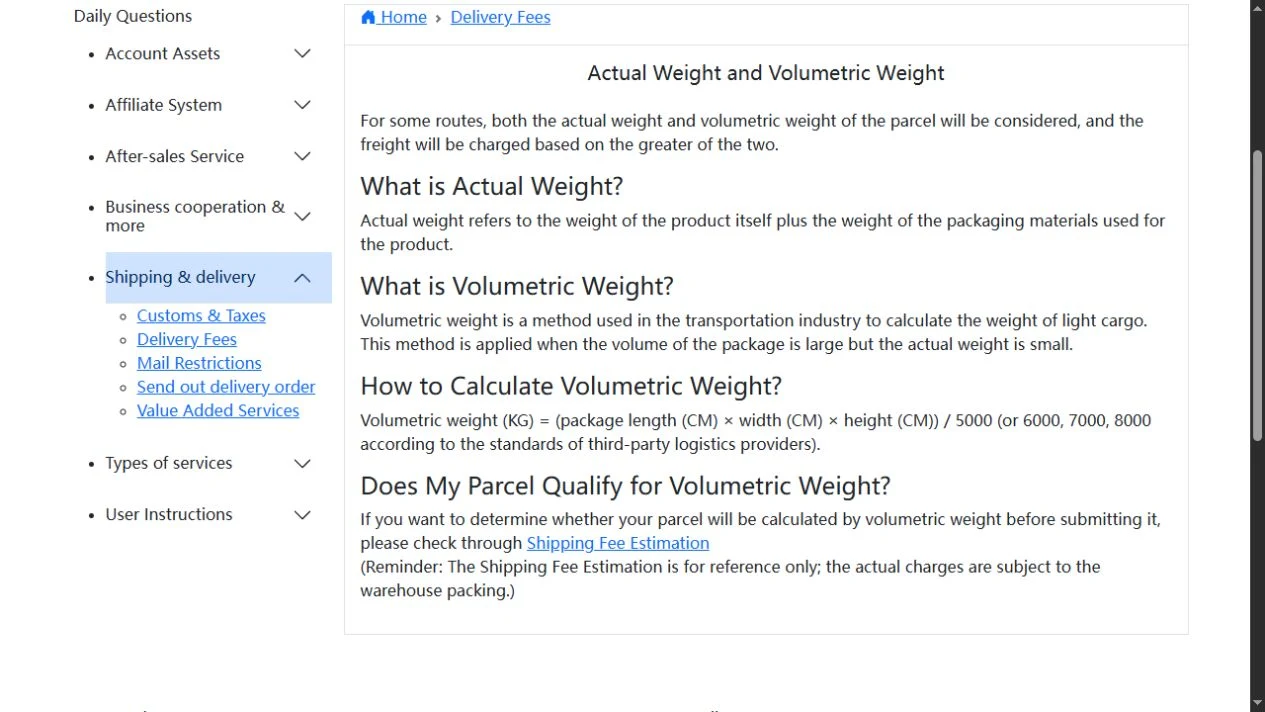
Joyagoo's weight explanation describes volumetric weight as parcel length multiplied by width and height, divided by the logistics provider's applicable divisor. The dimensions are in centimetres. The page lists examples of different divisors, not one universal number for every route.
Some services compare actual and volumetric weight and use the greater value. That relationship explains why a light object can still occupy a costly amount of space. It does not establish the price per kilogram, rounding steps or all other charges for a particular service.
A transparent example, not a shipping quote
Suppose a hypothetical packed parcel measures 40 × 25 × 24 cm and has an actual weight of 2.8 kg. Its volume is 24,000 cubic centimetres. With an illustrative divisor of 6,000, the volumetric result is 4.0 kg.
For a service applying the greater of these two weights, 4.0 kg would be the larger figure before any additional route-specific calculation. The dimensions, weight and divisor in this example are teaching inputs. They are not measurements from a customer order or evidence of an available carrier rate.
Test a packing change
If the same hypothetical parcel's height becomes 20 cm while length and width stay unchanged, its volume becomes 20,000 cubic centimetres. Dividing by the same illustrative 6,000 gives approximately 3.33 kg. This shows how one changed dimension affects the formula; it does not guarantee a particular monetary saving.
Ask what was removed to achieve the change. Protective packaging may be necessary even if it adds volume. A calculation that ignores the protection required for the goods is not a useful comparison of the parcel you will actually send.
Record why a new estimate differs
Check whether the difference comes from contents, packaging, destination, service, currency or a revised measurement. Keep the earlier and later assumptions visible rather than interpreting every price change as an unexplained fee.
Read shipping conditions for country and service questions, then use warehouse planning before submitting a parcel. If adding another find from the catalog, update the contents and estimated size instead of assuming it fits the previous calculation unchanged.